Healthy Streets


Alki Point - 12 on map
Aurora-Licton Springs - 4 on map
Ballard - 5 on map
Beacon Hill - 9 on map
Bell Street - 8 on map
Central District - 7 on map
Columbia City - 10b on map
Delridge - 14a on map
Greenwood - 3 on map
Georgetown - 11 on map
Highland Park - 14b on map
High Point - 13 on map
Hillman City - 10c on map
Lake City - Olympic Hills - 1a on map
Lake City - Cedar Park - 1b on map
Little Brook - 2 on map
Mt Baker - 10a on map
Othello - 16a on map
Rainier Beach - 16b on map
South Park - 15 on map
Wallingford - 6 on map
How do Healthy Streets work?
- Healthy Streets can incorporate safety features like easier crossings at busy streets, speed humps to slow down drivers, and sign and pavement markings to help people find their way
- Healthy Streets have fixtures like concrete block bases and new painted curb bulbs at each intersection of permanent healthy streets
- In some cases, SDOT may install traffic calming, street murals, and additional pedestrian design elements
- Street Closed signage is installed in the space directly adjacent to the intersection where parking is already not authorized. No legal street parking spaces are removed to install Healthy Street signs.
What this means for Healthy Street Neighborhoods:
- People are welcome to use the full width of the street for walking, rolling or playing while being mindful of others and sharing the space safely.
- Healthy streets can be used for neighborhood activities (like hopscotch and basketball) that you would otherwise need to get a street closure permit for
- Healthy Streets can also be used to host Play Streets and block Parties without needing a permits
- People driving who need to get to homes and destinations along Healthy Streets can still drive on these streets
- Drivers should use extra caution and yield to people
- People enjoying the street should be mindful of drivers trying to get to homes and destinations
- At some intersections, we can install Healthy Street Planters. Neighbors are responsible for maintaining them. We will reach out when there’s an opportunity to sign up for planters.
How Healthy Streets Started
In response to the COVID-19 pandemic, in 2020 we upgraded 25 miles of existing Neighborhood Greenways to ‘Stay Healthy Streets’, by closing them to pass through traffic. We selected streets by working from the Neighborhood Greenway network and avoiding impacts to businesses, fire response routes, transit operations and layover, and COVID19 response efforts like healthcare provider parking.
What began as a program to provide space for social distancing grew in popularity as streets became opportunities for social connection, play and exercise. In 2020 it was announced that 20 miles of Healthy Streets would be made permanent, and communities began to imagine these streets as a long-term benefit to their neighborhoods. Later, this program was renamed to ‘Healthy Streets’.
What's Next for Healthy Streets
We’ve heard from people that Healthy Streets are a valued part of many neighborhoods and there is a strong desire to add more locations. In 2022 Mayor Harrell signed the Executive Order on Climate Change and confirmed Seattle’s commitment to make 20 miles of Healthy Streets permanent.
As a first step towards that goal, we evaluated many Healthy Streets installed in 2020 and collected community feedback on which Healthy Streets to make permanent. We identified several locations where there is strong community support to make Healthy Streets permanent. We’ve been making some Healthy Streets permanent, returning some to Neighborhood Greenways, and continue to evaluate others.
The Healthy Streets program currently focuses on Neighborhood Greenways, and we do not have an open application process for new Healthy Streets. If future funding is identified to make this an ongoing program, we will develop a process to identify and prioritize future locations.
Community Feedback
When Healthy Streets started, we chose which neighborhoods to focus on using the Race and Social Equity Index. We also considered neighborhoods that already had greenways in areas with dense housing or not much public open space. This way, more people could have places to go outside and enjoy nature without having to go far from their homes. We also made sure to include neighborhoods that had access to important services and businesses that people need in their daily lives. This way, everyone in those neighborhoods could have better opportunities to live healthy and active lives.
Since the program began, we’ve regularly talked to communities and distributed surveys to understand how Healthy Streets are working, where they can be improved and expanded, and where it might make sense to go back to a Neighborhood Greenway. We also observed and reviewed each Healthy Street to help inform our decision-making. For more information about how community feedback was used, please review our Healthy Street Evaluations in the materials section below.
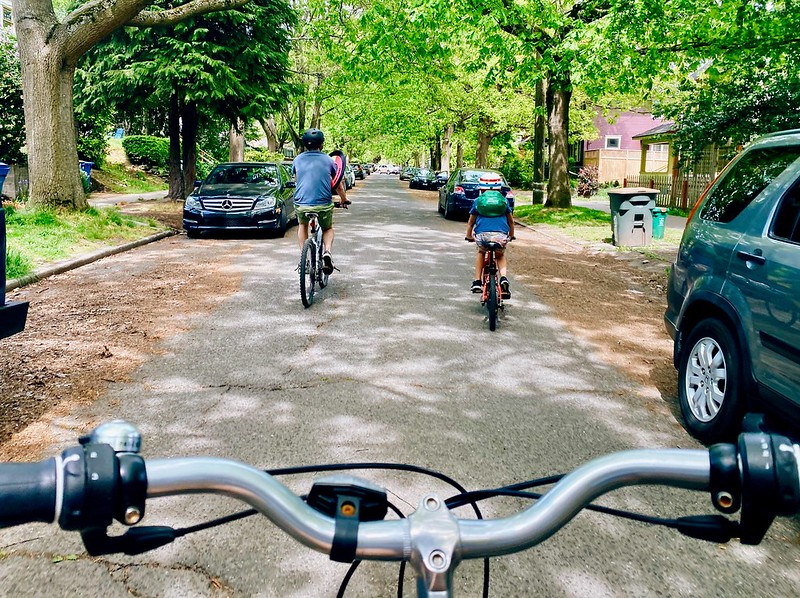
Our family loves the 25th Ave Healthy Street. I've been surprised by how much it's impacted our neighborhood's quality of life. What has been a wonderful, unexpected aspect is seeing how the whole neighborhood uses the space. — M. Mainland, Central District
Additional Languages
Check out our PowerPoint videos for more info: English • Español • አማርኛ • Tiếng việt • af-Soomaali • 한국어 • 简体中文 • 繁体字 • Tagalog • ትግርኛ
Translations:
If you need this information translated, please call (206) 900-8760.
如果您需要此信息翻譯成中文 請致電 (206) 900-8760.
Kung kailangan mo ang impormasyon na ito na nakasalin sa Tagalog mangyari lamang na tumawag sa (206) 900-8760.
Si necesita traducir esta información al español, llame al (206) 900-8760.
Odeeffannoon kun akka siif (206) 900-8760.
Nếu quý vị cần thông tin này chuyển ngữ sang tiếng Việt xin gọi (206) 900-8760.
የዚህን መረጃ ትርጉም ከፈለጉ፣ በዚህ ስልክ ቁጥር ይደውሉ፡ (206) 900-8760.
ናይዚ ሓበሬታ ትርጉም እንተደሊኹም፣ በዚ ቁጽሪ ስልኪ ይድውሉ፡ (206) 900-8760.
당신이 번역이 정보를 필요로하는 경우에, (206) 900-8760? 전화 해주십시오.
Program Library
- Frequently Asked Questions (August 2025)
- Overview presentation (March 2021)
- Traffic diversion data analysis (shows traffic diversion after Rainier Ave S changes and during the Lake Washington Blvd Keep Moving Street - March 2021)
- Play on your Healthy Street flyer (2025)
- Play on your Healthy Street printable sign (May 2023)
- Healthy Streets Planter Requests
- View photos on our Flickr site
- Email update archive
2024 Healthy Street evaluations:
2023 Healthy Street evaluations:
2021/2022 Healthy Street evaluations:
- Alki Point
- Aurora Licton Springs
- Ballard
- Bell Street
- 22nd Ave East (Central District)
- 25th Ave South (Central Distict)
- East Columbia Street (Central District)
- Delridge-Highland Park
- Georgetown
- Greenwood
- Lake City
- Little Brook
- North Beacon Hill
- Rainier Valley North
- Rainier Valley South
Current Healthy Streets survey:
Previous Survey Results:
- Online survey results dashboard
- Click for PDFs of question 5 and question 19 which don't show up well in the dashboard)
- Lake Washington Pilot Summary
- Lake Washington Pilot Public Comments
- Lake Washington Blvd Public Comments (Aug 30 - Sept 4)
- Announcing Stay Healthy Streets (April 2020)
- Stay Healthy Streets continue this week and will add 3 new neighborhoods this weekend (April 2020)
- 2020 bike investments to accelerate, including 20 miles of Stay Health Streets to become permanent in Seattle (May 2020)
- 4 Miles of Stay Healthy Streets Announced along with a 5-day Pilot on Lake Washington Blvd (June 2020)
- Lake Washington Blvd opens to people walking, rolling, and biking 24/7 from July 28 to September 8 (July 2020)
- Three miles of Lake Washington Blvd will stay open to people walking, rolling, and biking until the week of Oct. 5 (September 2020)
- Starting 4th of July weekend, 3 miles of Lake Washington Blvd (from Mt Baker Park to Seward Park) will open to people walking, rolling, and biking on weekends & holidays through at least September (June 2021)
- Trick or Streets are back! Here's how you can participate this year (October 2021)
- Find out what’s next for Healthy Streets in Seattle (October 2022)
- Share your input on the design of the Alki Point Healthy Street (November 2022)