RainWise
Get rebates that cover most or all of the cost of installing cisterns and/or rain gardens on your property.
$4,000 average annual savings
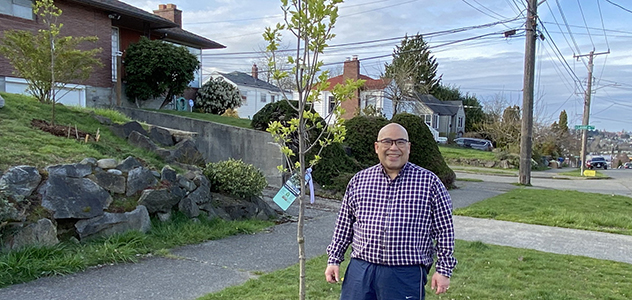
Tree for Neighborhoods provides Seattle residents with a free tree that is right for them and ready for Seattle’s changing climate. Participants get access to free, hands-on support and training, and help choosing, permitting, and learning to care for your tree.
By planting a tree with us you are adding beauty to where you live and helping to sustain a healthy environment and livable neighborhoods for everyone.
The application opens and closes in July, and trees are delivered in October and November.
The 2026 program has closed. Sign up to get notified about next year’s program by email.
What you will receive:
For those who need physical help planting their tree, assistance is available on a limited basis.
How much can I save with this program?
With this program, you can expect to save an average of $200 annually.
After the application closes, Trees for Seattle will begin processing applications. You will receive an email with the status of your tree application once all applications are processed.
Q: When does the application open and how do I apply?
A: Applications open in July each year and remain open for about 6 weeks. Please review the information on our website and consider the space you have in your yard and in your planting strip before submitting your application.
Q: Will I get the tree(s) I applied for?
A: The City of Seattle is committed to equitably increasing the tree cover city-wide and prioritizes neighborhoods that currently have fewer trees. Most of these neighborhoods overlap with Environmental Justice Priority Areas. Trees for Neighborhoods uses a weighted lottery for applications we receive, meaning applications from low canopy neighborhoods will be more likely to receive trees. As we process applications in lottery order, we assess what trees are available and distribute requested trees until they are “sold out.” You may be “Waitlisted” for the tree you want. If you are "Waitlisted" for a tree, it is possible that you can become "Approved" for that tree as late as October or November. If you would like to request an available species rather than stay on the waitlist, contact us at TreesForNeighborhoods@Seattle.gov with your new request and we will update your application to reflect the change.
Q: Can I submit more than one application to improve my chances?
A: No, only one application per household will be considered. We will only process the first application we receive from your address. If you submit your application and would like to make a change before the application closing date, please contact us at TreesForNeighborhoods@Seattle.gov and we will make that change on your behalf.
Q: Can I still apply for trees if I rent my house?
A: Yes! However, you should get permission from the homeowner before you apply for trees. Consider who will take care of the trees (i.e., pruning and watering) during the tree’s crucial establishment years (first five years after planting).
Q: Is there a limit on the number of trees I can receive through Trees for Neighborhoods?
A: Yes. You can apply for up to three trees per year per address for a lifetime total of six trees per address. We set this limit to make sure a greater number of Seattle residents have an opportunity to participate in the program.
Q: Is there help available if I’m physically unable to pick up and plant a tree?
A: Yes. We can help participants who are physically unable to plant a tree themselves. Because young trees need a great deal of care and because we are unable to provide long-term maintenance for all of our trees, it is critical that you or someone you know can water the tree for at least the first five summers after it is planted. Please give us a call at (206) 684-3979 or email us at TreesForNeighborhoods@Seattle.gov to inquire about tree planting assistance.
Q. What if I applied for a tree and don’t want it anymore?
A: Please let us know ASAP so we can find the tree a new home! Email us at TreesForNeighborhoods@Seattle.gov and let us know that you are releasing your tree so we can give it to someone on the waitlist.
July: Application opens and closes
August: Update on tree status from your application with next steps in the process
October: Planting and care workshops
October – November: Trees are delivered
Watch a video presentation of our Right Tree, Right Place webinar. This will help you make the best decision about where to plant your tree. Choosing the right tree species is an important part of assessing what tree is right for your space.
Every year we offer a different mix of tree species to choose from.
Q: How do you choose what species are included?
A: We strive to offer around 12 species each year that the public will be most interested in planting. We offer a range of trees from those small enough to go under power lines to large trees that offer the greatest benefits such as storm water reduction. We also offer species that are appropriate as street trees. We include at least one native species. We never include invasive species or species that are susceptible to pests and disease, such as ash. We try to avoid species that are over-planted in Seattle, such as maple.
Q: Why don’t you have more native trees?
A: We offer at least one native species every year, and usually more. However, while a given species of tree may be considered native to this region that does not mean it will survive or is appropriate in the harsh urban landscape. For example, our native conifers need a large space, which is often not available in small residential plots, and very rarely in street tree locations. We carefully select trees that have been shown to do well in city conditions, including pavement, compaction, and increased air pollution. These are conditions that some of our native trees are not well suited for.
Q: Why don’t you offer fruit trees?
A: Fruit trees are amazing, and occasionally we have offered them. However, our goal is to increase healthy tree canopy in Seattle. Fruit trees do not get us very far towards that goal as they are most often dwarf or pruned small in an attempt to control size to more easily reach fruit. Our focus is on increasing the number of large and evergreen trees in Seattle, as these are the trees that do the most to improve air and water quality. Another concern with fruit trees is that they tend to have more insect and disease problems than other trees. By Washington State law, homeowners are required to control insect pests in trees on their property. We strive to provide trees that are least likely to have insect and disease problems. Controlling pests in fruit trees is labor and time-consuming work.In addition, Washington State University points out that if pests are not carefully controlled in backyard fruit trees our commercial orchards are threatened. Once mature, fruit trees create an abundance of fruit, often beyond what one family can eat. If you find yourself in that situation, don’t let the food go to waste! Our partners at City Fruit can help harvest that fruit and put it to good use.
Q: Can I request a tree that’s not on your planting list?
A: No.Our species list is set well in advance to ensure supply. You can, however, send us suggestions for trees you would like to see offered in the future and we will take that into consideration.
Q: Will you have X species of tree next year?
A: We rotate the species of trees we plant every year to avoid the overplanting of any given species. We do not know what species will be offered in any given year until the spring.
Q: Why don’t you provide shrubs/understory plants?
A: The focus of Trees for Neighborhoods is to build tree canopy cover in residential areas. Shrubs and understory plants, while important, do not achieve that goal and we do not have any funding to provide them.
Q: Why don’t you offer trees that are larger when planted?
A: We try to strike a balance between a tree that is large enough to make an immediate difference to the landscape when planted, yet small enough for the average person to carry, transport, and plant themselves.
Q: What trees have you offered in the past?
A: See the table below for a full list.
Attention renters! If you do not own your home, you need to ask the permission of the homeowner before applying for trees. Young trees need regular summer watering through their first five years. If you do not plan to be at your home that long, consider how the young tree will receive the proper care it needs.
Attention landlords! Attention landlords! If you apply for trees for one of your rental properties, please consider future watering and maintenance. If you are unable to water the trees two times per week during the summer months, please be sure your renter is willing.
We will deliver the trees to your home. You must attend a Planting and Care workshop to get delivery of your tree(s). Indicate which workshop you will attend on the application to get delivery of your tree(s).
On the application, please describe where on your property our staff should leave your tree(s), water bag(s), and mulch, e.g., north side of garage, next to front porch steps, inside front yard gate, etc.
It may take up to a month or more for us to deliver all the trees to your homes. The trees will be in five-, seven-, or 10-gallon containers and are generally four to six feet tall.
Yes. All trees should be planted within one month after receiving them. You are responsible for planting the tree, which is why we require each participant to go through the Planting and Care training. If you are physically unable to plant your tree and would like assistance, please contact us.
Q: Why do I have to go through a planting and care workshop?
A: We are proud of this program’s 88% survival rate 10 years after a tree was planted. Your participation in planting and care workshops is part of what creates that success. It is a waste of resources to plant trees that die. We have structured the program to avoid this as much as possible. Teaching program participants how to avoid common yet often deadly tree planting mistakes is one of the best ways to do this, as you are ultimately the person who will determine the future health of your tree. Every year we receive feedback from participants, including experienced landscapers and gardeners, who tell us that they thought they knew everything about trees yet learned something new. We respect your time and strive to keep the workshops short and to the point and appreciate your understanding and open-mindedness. Your willingness to go through the workshop helps keep the program successful.
Q: Can I attend a planting and care workshop for my neighbor?
A: We love to see neighbors working together! We encourage the person who plans on planting and caring for the tree to attend the workshop, so tree recipients learn how to avoid deadly tree planting mistakes and how to care for their tree in the long-term. If you plan to plant and care for your neighbor's tree, you can attend the planting and care workshop for them.
Your young trees will not survive the dry summer without watering. Water bags will be provided to help you care for your trees in the summer.
Q: How can I get help caring for my tree after it is planted?&
A: Each summer Trees for Neighborhoods visits all of the street trees planted through the program in the last two years to evaluate tree health. The crew leaves an evaluation card at each house they visit to give you some tips on how to care for your trees. We do not conduct visits to yard trees because we would need permission to enter each property. Please do not hesitate to call or email The Garden Hotline experts with questions or concerns about your tree. If you need a tree assessment or your tree needs some care, you should contact an ISA certified arborist.
Email: TreesForNeighborhoods@Seattle.gov
Call: (206) 327-2434
View all Assistance and Discount Programs
Get rebates that cover most or all of the cost of installing cisterns and/or rain gardens on your property.
Income-qualified renters and homeowners can get free insulation, furnace repairs, and more.
Free smoke/CO or strobe alarms for seniors 65+, low-income households, and people with disabilities.
Get money to fix a health or safety issue if you are a homeowner with an income that qualifies.